
Delhi Egg Rate Today
Updated 30th August 2026 · Source: NECC Delhi (CC)
Today’s Rate
₹6.00 /piece
Tray Price
₹180.00 (30 Eggs)
Retail Price
₹6.72
Supermarket Rate
₹6.60
Updated on ₹30th August 2026: Today’s Delhi egg rate is ₹6.00 per egg. A tray of 30 eggs is available for ₹180.00, while 100 eggs are priced at ₹600.00 and 1 peti costs ₹1,260.00. Today’s retail and supermarket rates in Delhi are ₹6.72 and ₹6.60. Explore egg rates summary and trend for this month along with the latest Delhi market prices below.
PRICE TREND
Delhi Egg Rate Summary and Trend
Explore recent movements in Delhi egg prices through a monthly summary and interactive price chart. Review the highest, lowest, and average rates to understand how the local market has performed over recent days.
Highest
₹6.00 on 30 Aug
Lowest
₹5.30 on 5 Aug
Average
₹5.46 So far this month
FULL BREAKDOWN
Delhi (CC) Egg rates (last 30 days)
View Delhi egg rates from the last 30 days, including rates per egg, wholesale, tray, 100 eggs, and peti. Use the table below to compare daily price changes and follow recent market activity.
| Date | Piece (₹) | Wholesale (₹) | Tray/30 (₹) | 100 Pcs (₹) | Peti/210 (₹) |
|---|---|---|---|---|---|
| 30 Aug 2026 | ₹6.00 | ₹5.88 | ₹180.00 | ₹600.00 | ₹1,260.00 |
| 29 Aug 2026 | ₹6.00 | ₹5.88 | ₹180.00 | ₹600.00 | ₹1,260.00 |
| 28 Aug 2026 | ₹5.75 | ₹5.64 | ₹172.50 | ₹575.00 | ₹1,207.50 |
| 27 Aug 2026 | ₹5.60 | ₹5.49 | ₹168.00 | ₹560.00 | ₹1,176.00 |
| 26 Aug 2026 | ₹5.60 | ₹5.49 | ₹168.00 | ₹560.00 | ₹1,176.00 |
| 25 Aug 2026 | ₹5.60 | ₹5.49 | ₹168.00 | ₹560.00 | ₹1,176.00 |
| 24 Aug 2026 | ₹5.47 | ₹5.36 | ₹164.10 | ₹547.00 | ₹1,148.70 |
| 23 Aug 2026 | ₹5.40 | ₹5.29 | ₹162.00 | ₹540.00 | ₹1,134.00 |
| 22 Aug 2026 | ₹5.40 | ₹5.29 | ₹162.00 | ₹540.00 | ₹1,134.00 |
| 21 Aug 2026 | ₹5.40 | ₹5.29 | ₹162.00 | ₹540.00 | ₹1,134.00 |
| 20 Aug 2026 | ₹5.40 | ₹5.29 | ₹162.00 | ₹540.00 | ₹1,134.00 |
| 19 Aug 2026 | ₹5.40 | ₹5.29 | ₹162.00 | ₹540.00 | ₹1,134.00 |
| 18 Aug 2026 | ₹5.40 | ₹5.29 | ₹162.00 | ₹540.00 | ₹1,134.00 |
| 17 Aug 2026 | ₹5.40 | ₹5.29 | ₹162.00 | ₹540.00 | ₹1,134.00 |
| 16 Aug 2026 | ₹5.40 | ₹5.29 | ₹162.00 | ₹540.00 | ₹1,134.00 |
| 15 Aug 2026 | ₹5.40 | ₹5.29 | ₹162.00 | ₹540.00 | ₹1,134.00 |
| 14 Aug 2026 | ₹5.40 | ₹5.29 | ₹162.00 | ₹540.00 | ₹1,134.00 |
| 13 Aug 2026 | ₹5.40 | ₹5.29 | ₹162.00 | ₹540.00 | ₹1,134.00 |
| 12 Aug 2026 | ₹5.40 | ₹5.29 | ₹162.00 | ₹540.00 | ₹1,134.00 |
| 11 Aug 2026 | ₹5.40 | ₹5.29 | ₹162.00 | ₹540.00 | ₹1,134.00 |
| 10 Aug 2026 | ₹5.40 | ₹5.29 | ₹162.00 | ₹540.00 | ₹1,134.00 |
| 09 Aug 2026 | ₹5.40 | ₹5.29 | ₹162.00 | ₹540.00 | ₹1,134.00 |
| 08 Aug 2026 | ₹5.40 | ₹5.29 | ₹162.00 | ₹540.00 | ₹1,134.00 |
| 07 Aug 2026 | ₹5.40 | ₹5.29 | ₹162.00 | ₹540.00 | ₹1,134.00 |
| 06 Aug 2026 | ₹5.35 | ₹5.24 | ₹160.50 | ₹535.00 | ₹1,123.50 |
| 05 Aug 2026 | ₹5.30 | ₹5.19 | ₹159.00 | ₹530.00 | ₹1,113.00 |
| 04 Aug 2026 | ₹5.30 | ₹5.19 | ₹159.00 | ₹530.00 | ₹1,113.00 |
| 03 Aug 2026 | ₹5.30 | ₹5.19 | ₹159.00 | ₹530.00 | ₹1,113.00 |
| 02 Aug 2026 | ₹5.30 | ₹5.19 | ₹159.00 | ₹530.00 | ₹1,113.00 |
| 01 Aug 2026 | ₹5.30 | ₹5.19 | ₹159.00 | ₹530.00 | ₹1,113.00 |
About Delhi Egg Market
Delhi is one of the largest egg consumption and wholesale trading markets in North India. The city does not produce eggs at scale itself, but it receives massive daily arrivals from surrounding production states. This makes it a major redistribution point for eggs moving across the northern region.
The Delhi (CC) rate published by NECC stands for Consuming Centre, which tells you exactly what Delhi is in this market. It is a consumption city, not a production hub. The price here reflects the cost of producing eggs elsewhere, plus the cost of getting them to Delhi.
Delhi NCR’s sheer size creates a massive and steady demand throughout the year. With millions of households, thousands of restaurants, hotels, caterers, food manufacturers, and institutional buyers all purchasing eggs daily, the market moves large volumes every single day.
Traders and wholesalers across North India watch the Delhi egg market rate closely because it signals broader demand conditions in the region. If prices move in Delhi, nearby markets in Haryana, Uttar Pradesh, and Rajasthan often follow within a day or two.
The Delhi (CC) NECC rate is updated every morning and reflects the current wholesale benchmark for one of India’s most active egg trading markets.
Delhi Egg Mandi and Wholesale Market
The Delhi egg mandi is where daily wholesale egg trading actually happens. Eggs arrive from production states in large consignments, are received by commission agents, and then distributed to wholesale buyers across the city and surrounding areas.
Ghazipur Murga Mandi is the most well-known poultry and egg trading market in Delhi. It handles a significant share of the daily egg arrivals for the Delhi NCR region. Traders from across the city visit or place orders through agents here every morning as soon as the day’s rate is declared.
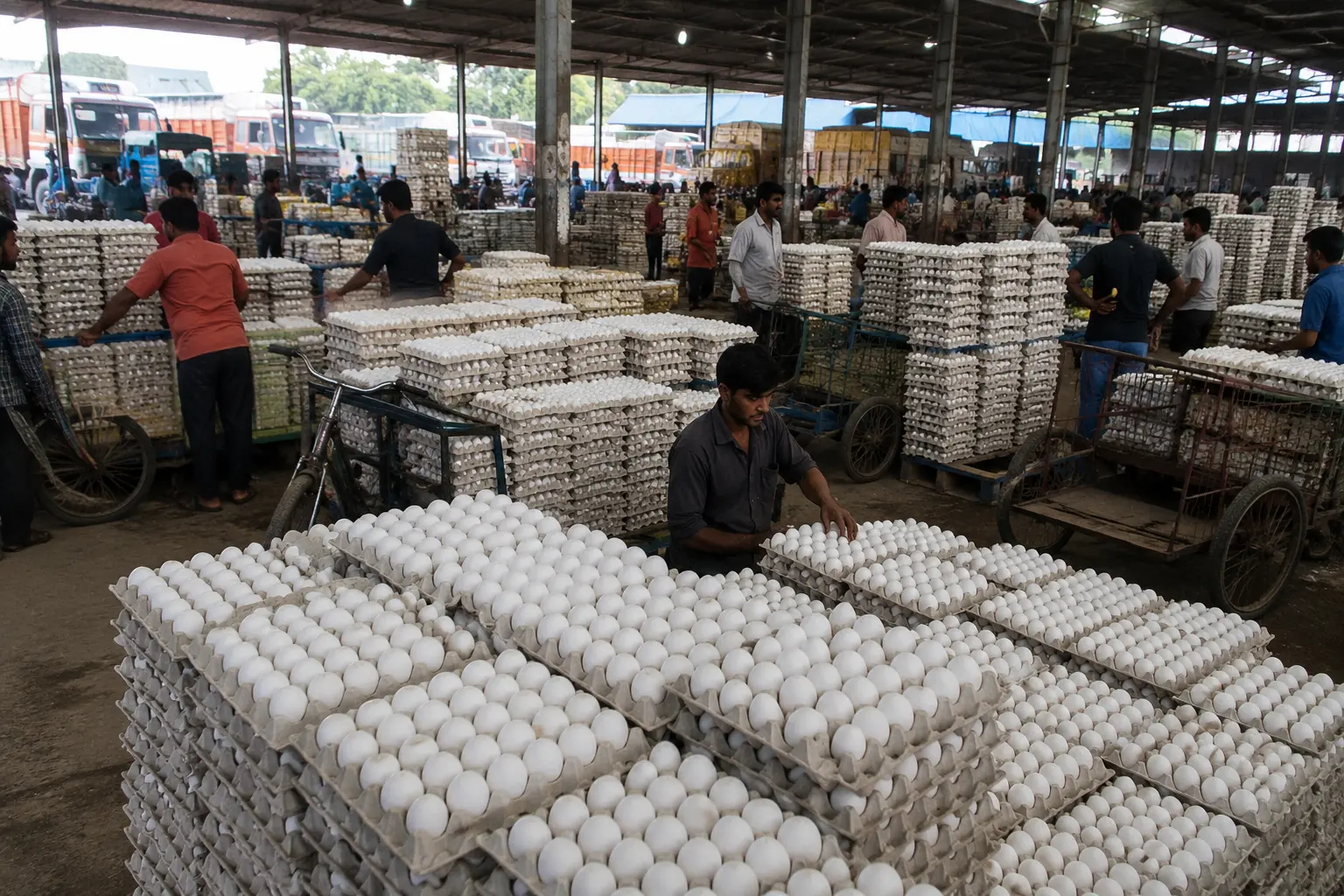
The relationship between the Delhi mandi egg rate and the NECC published rate is straightforward. NECC provides the morning benchmark. The mandi rate then settles close to it, adjusted slightly by that day’s actual arrivals and buying activity. On most days the two figures are very close, sometimes identical.
Wholesale buyers typically purchase eggs in trays of 30 or in peti units of 210 eggs. Large buyers such as hotel chains, catering companies, and food processors often negotiate directly with commission agents for bulk quantities at slightly better rates than the open mandi price.
Monitoring the Delhi egg mandi rate every morning helps businesses lock in stock at the right price before the market moves. Even a difference of ₹0.25 per egg adds up to thousands of rupees on a large order.
What Affects Delhi Egg Prices?
Delhi does not set its own egg prices in isolation. The daily rate here is shaped by what happens at production farms hundreds of kilometers away, by how much the city demands each day, and by how smoothly eggs can travel from farm to market. Here is a closer look at each factor.
Supply from Production Centers
Almost all eggs sold in Delhi arrive from outside the city. The main supply sources are:
| Source | Key Contribution | Impact on Delhi Rate |
|---|---|---|
| Barwala, Haryana | Largest single supplier for Delhi. One of India’s biggest egg production centers. | Barwala production levels directly influence the Delhi mandi rate on any given day. |
| Other Haryana Regions | Additional layer farms spread across Hisar, Sirsa, and surrounding districts. | Supplements Barwala supply. Reduces rate volatility when Barwala supply is tight. |
| Punjab | Significant commercial poultry farming across Ludhiana and surrounding areas. | Adds volume during peak demand periods. Helps stabilize rates during festivals. |
| Uttar Pradesh | Layer farms in districts like Bareilly and Aligarh supply local Delhi NCR demand. | Shorter transport distance keeps costs lower for UP-sourced eggs reaching east Delhi. |
When any of these supply sources face disruption, whether from disease in flocks, poor weather, or transport issues, Delhi egg rates rise quickly. The city has no significant local production to fall back on.
Demand Across Delhi NCR
Delhi NCR is a consumption giant. The size and diversity of buyers here creates sustained year-round demand that keeps volumes high even when prices shift.
- Households: Over 3 crore residents in Delhi alone, with eggs being one of the most common daily food items across income groups.
- Hotels and restaurants: Delhi’s hospitality sector is one of the largest in the country. High-volume daily purchases from five-star hotels to dhabas make this segment a major demand driver.
- Caterers and event industry: Large-scale catering operations for weddings, corporate events, and government functions consume eggs in very high volumes, especially from October to February.
- Retail stores and supermarkets: Modern retail chains and traditional kirana stores both stock eggs daily. Organized retail demand has grown steadily as supermarkets expand across NCR.
- Bakeries and food manufacturers: Industrial buyers in the food processing sector purchase eggs in bulk. Bread, biscuit, and snack manufacturers are consistent large-volume buyers throughout the year.
- Institutions: Schools, hospitals, government canteens, and defence establishments all procure eggs regularly, often through fixed supply contracts at benchmark rates.
Demand peaks sharply between October and February, when weddings, festivals, and cooler weather all increase egg consumption simultaneously. During this period, the Delhi NCR egg rate typically rises and stays elevated until spring.
Transportation and Daily Market Activity
Because Delhi depends entirely on outside supply, transportation is a critical part of what determines the final egg price here.
- Fuel prices: Most eggs arrive by truck. When diesel costs rise, transport charges increase, and those extra costs are passed on through the supply chain to the mandi rate.
- Distance from source: Eggs from Barwala travel roughly 150 km to reach Delhi. Eggs from Punjab or UP travel further. Longer routes mean higher transport costs built into the final price.
- Daily arrivals: The volume of eggs arriving at Delhi mandis each morning directly affects the opening rate. Heavy arrivals push prices down; short supply pushes them up.
- Road conditions and weather: Monsoon flooding, fog in winter, or highway closures can delay consignments and cause short-term price spikes even when farm production is normal.
- Perishability: Eggs have a short shelf life and cannot be held in storage to time the market. Sellers need to move stock daily, which creates predictable pricing pressure at the mandi.
Even a one-day delay in arrivals from Barwala can noticeably tighten the Delhi mandi supply, causing the rate to move within hours of the market opening.
Why Businesses Monitor Delhi Egg Rates Daily?
Egg prices in Delhi can move every single day. For businesses that buy or sell eggs regularly, checking the rate each morning is not optional. It is part of running the operation correctly.
Conclusion
Delhi is a consumption-driven market where egg prices are shaped by supply from Barwala, Haryana, Punjab, and Uttar Pradesh, by the city’s enormous and diverse daily demand, and by how efficiently eggs move through the supply chain each morning.
The daily NECC Delhi rate gives traders, businesses, and buyers a reliable reference point to work from. Tracking it consistently, alongside the Delhi egg mandi rate, is the most practical way to stay on top of price movements and make informed purchasing decisions.
This page is updated every morning with the latest Delhi egg rate so you always have an accurate, up-to-date number before the market opens.
Browse Egg Rates by City
Are you looking for egg prices in a specific city? Browse the cities below to view today’s live egg prices, historical price trends, and detailed local market information for each location.
QUESTIONS