
Today Egg Rate in India (Live NECC Egg Price)
Today egg rate in India is:
₹5.72 / piece
Tray Price
₹171.57 (30 Eggs)
Lowest Price Market
Hospet: ₹5.10 / egg
Highest Price Market
Kolkata: ₹6.30 / egg
Supermarket Rate
₹6.29
Today Egg rate across the country averaged ₹5.72 per egg as of 30th August 2026, while a tray of 30-egg costs near ₹171.57 at the national level. The cheapest market is Hospet (₹5.10), and the highest egg market is Kolkata (₹6.30) — a gap of ₹1.20.
Today’s NECC Egg Rates Across India
The table below shows today’s NECC egg prices across major markets in India, including rates per piece, tray, 100 eggs, and peti.
| Market ↕ | Piece (₹) ↕ | Tray (₹) | 100 Pcs (₹) | Peti (₹) |
|---|---|---|---|---|
| Ahmedabad (CC) | ₹5.90 | ₹177.00 | ₹590.00 | ₹1,239.00 |
| Ajmer | ₹5.70 | ₹171.00 | ₹570.00 | ₹1,197.00 |
| Barwala | ₹5.61 | ₹168.30 | ₹561.00 | ₹1,178.10 |
| Bengaluru (CC) | ₹5.70 | ₹171.00 | ₹570.00 | ₹1,197.00 |
| Brahmapur (OD) | ₹5.80 | ₹174.00 | ₹580.00 | ₹1,218.00 |
| Chennai (CC) | ₹5.80 | ₹174.00 | ₹580.00 | ₹1,218.00 |
| Chittoor | ₹5.73 | ₹171.90 | ₹573.00 | ₹1,203.30 |
| Delhi (CC) | ₹6.00 | ₹180.00 | ₹600.00 | ₹1,260.00 |
| E.Godavari | ₹5.55 | ₹166.50 | ₹555.00 | ₹1,165.50 |
| Hospet | ₹5.10 | ₹153.00 | ₹510.00 | ₹1,071.00 |
| Hyderabad | ₹5.25 | ₹157.50 | ₹525.00 | ₹1,102.50 |
| Jabalpur | ₹5.60 | ₹168.00 | ₹560.00 | ₹1,176.00 |
| Kolkata (WB) | ₹6.30 | ₹189.00 | ₹630.00 | ₹1,323.00 |
| Ludhiana | ₹5.60 | ₹168.00 | ₹560.00 | ₹1,176.00 |
| Mumbai (CC) | ₹5.85 | ₹175.50 | ₹585.00 | ₹1,228.50 |
| Mysuru | ₹5.75 | ₹172.50 | ₹575.00 | ₹1,207.50 |
| Namakkal | ₹5.20 | ₹156.00 | ₹520.00 | ₹1,092.00 |
| Pune | ₹5.65 | ₹169.50 | ₹565.00 | ₹1,186.50 |
| Raipur | ₹5.35 | ₹160.50 | ₹535.00 | ₹1,123.50 |
| Surat | ₹5.85 | ₹175.50 | ₹585.00 | ₹1,228.50 |
| Vijayawada | ₹5.75 | ₹172.50 | ₹575.00 | ₹1,207.50 |
| Vizag | ₹5.55 | ₹166.50 | ₹555.00 | ₹1,165.50 |
| W.Godavari | ₹5.55 | ₹166.50 | ₹555.00 | ₹1,165.50 |
| Warangal | ₹5.27 | ₹158.10 | ₹527.00 | ₹1,106.70 |
| Allahabad (CC) | ₹6.00 | ₹180.00 | ₹600.00 | ₹1,260.00 |
| Bhopal | ₹5.45 | ₹163.50 | ₹545.00 | ₹1,144.50 |
| Indore (CC) | ₹5.60 | ₹168.00 | ₹560.00 | ₹1,176.00 |
| Kanpur (CC) | ₹6.00 | ₹180.00 | ₹600.00 | ₹1,260.00 |
| Lucknow (CC) | ₹6.00 | ₹180.00 | ₹600.00 | ₹1,260.00 |
| Muzaffurpur (CC) | ₹6.15 | ₹184.50 | ₹615.00 | ₹1,291.50 |
| Nagpur | ₹5.60 | ₹168.00 | ₹560.00 | ₹1,176.00 |
| Patna | ₹6.15 | ₹184.50 | ₹615.00 | ₹1,291.50 |
| Ranchi (CC) | ₹6.09 | ₹182.70 | ₹609.00 | ₹1,278.90 |
| Varanasi (CC) | ₹6.00 | ₹180.00 | ₹600.00 | ₹1,260.00 |
Compare Today’s Egg Prices by City
The following is the comparison chart which shows how today’s egg prices vary across major markets with an easy-to-read visual chart. Quickly identify the highest and lowest priced cities.
Rates Comparison Chart
National Egg Market Rates Today
Here is a quick overview of today’s national egg market, including NECC, wholesale, retail, and supermarket rates, along with the highest and lowest priced markets across India.
NECC Egg Price Trends
Explore how NECC egg rates have changed over time using the interactive chart below. Select a city and time period to compare historical price trends and understand how the market has moved.
Egg Price Calculator
Calculate the cost of eggs instantly using today’s live market rates. Enter the quantity you need to estimate prices for individual eggs, trays, 100 eggs, or petis. best for traders and retailers.
“Savings vs retail” assumes a ~15% retail markup over the entered rate — actual local retail prices may vary.
NECC Egg Rates
Overview of the NECC Egg Rates
What is the National Egg Coordination Committee (NECC)?
NECC: the National Egg Coordination Committee, is the body that sets India’s daily egg prices. It is a trade organization that connects egg producers, layer farm operators, poultry farmers, wholesalers, and market participants across the country under one pricing framework.
Every morning, NECC publishes a suggested wholesale egg price for major production centers and consumption markets. This published rate is what the entire Indian egg trade uses as its daily reference point.
Why do traders follow NECC prices? Simply because it gives everyone, buyers and sellers a common starting point. Without it, prices would vary unpredictably across hundreds of cities with no reliable baseline for negotiations.
The NECC rate is not legally binding. But in practice, most wholesale egg transactions across India are benchmarked against it every single day.
How NECC Sets Egg Prices?
NECC collects real market data from production hubs every morning before publishing the rate. Here is what goes into it:
- Production Levels
How many eggs are being produced at major layer farms in Namakkal, Barwala, Pune, and Hyderabad on that day. More supply generally means lower prices. - Market Demand
How much buyers across consumption centers want to purchase. If demand is high and supply is tight, the rate moves up. If supply is heavy and demand is slow, it comes down. - Regional Data
A city close to a production hub like Namakkal pays less than a city like Delhi that depends on long-distance supply. Regional differences are factored in before the rate is published. - Daily Feedback from the Market
Commission agents, wholesalers, and traders from across India report ground-level buying and selling activity back to NECC. This keeps the rate connected to what is actually happening in the market.
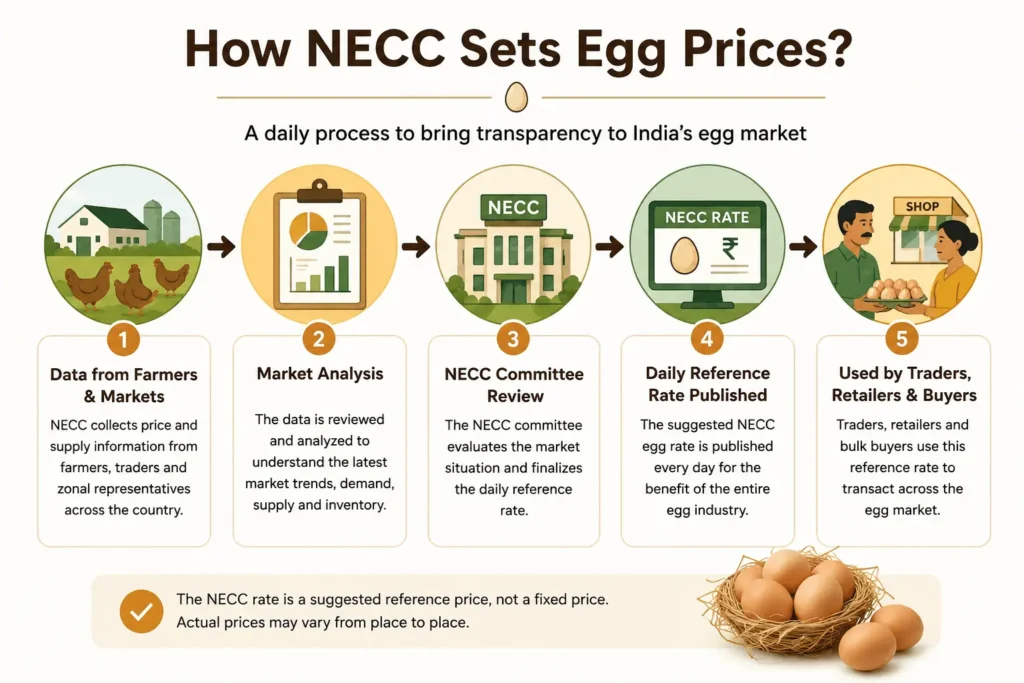
The final published rate is a suggested price, not a government rule. But because it reflects real supply, demand, and regional conditions, it is the most reliable daily reference the Indian egg market has.
Market Overview
India’s Egg Market Overview
India is one of the largest egg producers and consumers in the world. The poultry sector supports millions of farmers, commission agents, transporters, and traders across the country. To understand why egg prices move the way they do, it helps to understand how this market actually works.
Types of Egg Prices in India
When you look at egg prices, you will notice several different figures: NECC rate, wholesale rate, retail rate, and more. Each one means something different. Here is a simple breakdown:
OFFICIAL
NECC Rate
The suggested wholesale price published by NECC each morning. This is the national benchmark most egg traders in India use. It is what you see updated on this page daily.
TRADE
Wholesale Rate
The price at which large quantities of eggs actually change hands between producers, commission agents, and bulk buyers. Stays close to the NECC rate but can vary slightly based on order size and local supply.
MANDI
Paper Rate
The rate declared by local mandi associations or trader groups at the start of each trading session. Also called the open rate. It is the ground-level reference for transactions at local wholesale markets.
CONSUMER
Retail Rate
What you pay at a local shop or market stall. Typically 10 to 15% higher than the wholesale rate. The difference covers the retailer’s margin, breakage during handling, and last-mile delivery costs.
ORGANIZE RETAIL
Supermarket Rate
The highest price for the same egg. Supermarkets add costs for packaging, cold chain storage, quality grading, and higher store operating expenses. Expect to pay 15 to 25% more than the open market rate at a supermarket.
Egg Consumption in India
India consumes over 130 billion eggs every year. That number has been climbing steadily as incomes rise and more people add eggs to their regular diet.
Demand does not look the same everywhere though:
Urban Demand
City households buy eggs regularly and in larger quantities. Access to shops, stable incomes, and changing food habits drive strong, consistent urban demand throughout the year.
Rurar Demand
Rural buying is growing but is more sensitive to price. A ₹0.50 rise per egg can noticeably reduce volumes in rural markets. Affordability is the main driver here.
Seasonal Peaks
Demand jumps between October and February. Cooler weather, festivals like Diwali and Eid, and school exam seasons all push consumption higher at the same time, which puts upward pressure on prices.
Affordable Protien
At ₹6–7 per egg, eggs are one of the cheapest complete proteins available in India. This keeps baseline demand strong even when prices climb, because the alternatives, such as chicken, paneer, and fish, cost significantly more.
When consumption rises faster than supply can keep up, NECC rates reflect that pressure the very next morning. Demand is one of the fastest-moving inputs in daily egg pricing.
Poultry Industries in India
India is the third-largest egg producer in the world, after China and the United States. Nearly all of this production comes from commercial layer farms, large operations with thousands of hens specifically bred for egg laying.
130B+
Eggs produced annually
Top 3
Global egg producers
5 States
Produce most of India’s supply
24–48 hrs
Farm to market transit time
Where are most eggs produced? Five states handle the bulk of India’s commercial output:
Andhra Pradesh, Telangana, Tamil Nadu, Maharashtra, and Haryana. Large integrated layer farms in these states produce and move eggs to both nearby cities and distant markets through a wide network of commission agents and wholesale distributors.
The supply chain is fast. From a layer farm to a wholesale market to a retail shop typically takes 24 to 48 hours. Any disruption such as a road block, a vehicle shortage, or an outbreak at a farm shows up in prices quickly because there is very little buffer stock in this supply chain.
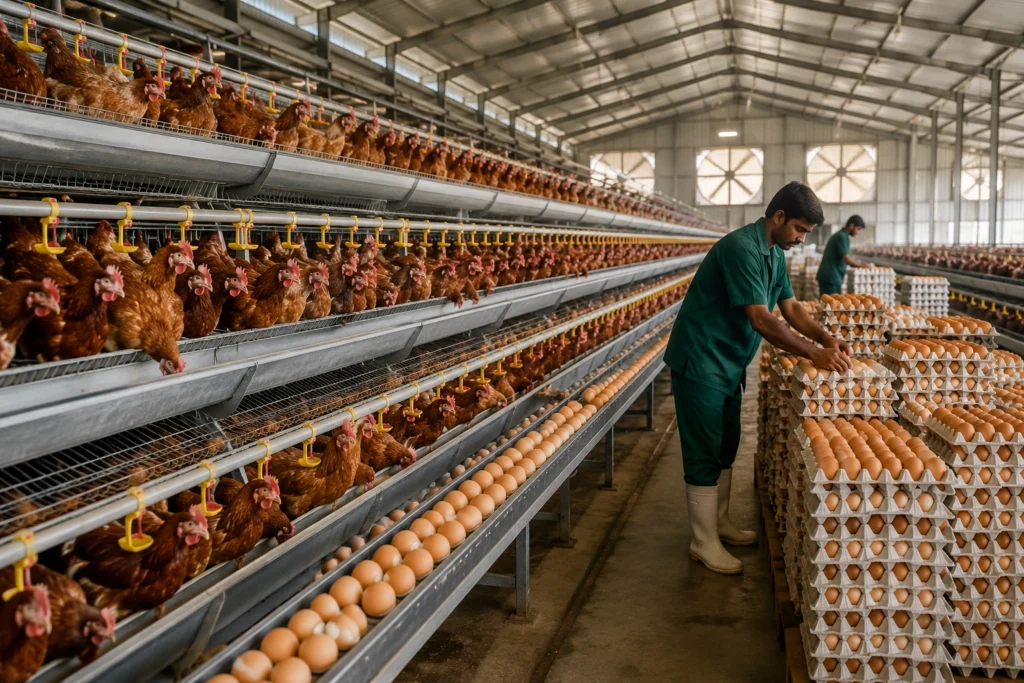
When production is strong and transport runs smoothly, prices stay steady or fall. When either breaks down, the NECC rate moves up. That connection between the farm and the daily price is direct and fast-moving.
Price Drivers
Factors Affecting Egg Prices in India
Egg prices do not move without a reason. Every rise or fall in the daily NECC rate connects back to one or more of the factors below. Knowing these helps you make better buying and selling decisions.
This is the biggest driver. When layer farms produce well and demand is normal, prices stay stable. The rate moves when the balance tips:
• Festival season demand spikes → prices rise
• A disease outbreak reduces flock size → prices rise
• Post-festival demand drops → prices fall
Even a small imbalance held over a few days can shift the NECC rate noticeably.
Feed makes up 60 to 70% of the total cost of producing an egg in India. The two main ingredients are maize and soybean meal.
When global commodity prices rise or a poor domestic harvest reduces supply, feed costs go up. Poultry farmers then either reduce their flock size or push for higher egg prices. Either way, the wholesale rate moves up within days.
India’s egg market has a very predictable annual cycle:
• Oct–Feb (Winter): Highest demand. Prices typically peak.
• Mar–May (Summer): Demand drops. Prices soften.
• Jun–Sep (Monsoon): Moderate demand with transport disruptions.
Traders who know this cycle can plan purchases and stock levels well in advance.
Weather affects both supply and the cost of getting eggs to market:
• Heat waves: Hens lay fewer eggs. Supply tightens.
• Heavy monsoon rains: Roads flood, transport slows, breakage increases.
• Severe winter cold snaps: Flocks in poorly insulated farms suffer losses exactly when demand is at its peak.
All three scenarios push the NECC rate up.
Eggs are fragile and perishable. They have to move quickly from farm to market. Transportation costs are built into the final price at every step of the supply chain.
• Higher diesel prices → higher delivery costs
• Road blocks or poor infrastructure → delays and spoilage
• Vehicle shortages in peak season → localized price spikes
This is why the same egg can cost ₹0.30 to ₹0.50 more per piece in a distant city compared to a nearby production hub.
Most cities in India do not produce their own eggs. Delhi, Mumbai, and Kolkata all depend on supply from states like Andhra Pradesh, Telangana, and Haryana.
When production drops in those states, distant cities feel it the most — because they have the least local supply to fall back on.
This is why city-specific egg rates matter. The NECC rate in Namakkal on any given day can be ₹0.50 to ₹1.00 lower than the rate in Delhi for exactly this reason.
Browse Egg Rates by City
Are you looking for egg prices in a specific city? Browse the cities below to view today’s live egg prices, historical price trends, and detailed local market information of each city.