
Egg Rate Today Hyderabad
Updated 30th August 2026 · Source: NECC Hyderabad
Today’s Rate
₹5.25 /piece
Tray Price
₹157.50 (30 Eggs)
Retail Price
₹5.88
Supermarket Rate
₹5.78
Updated on ₹30th August 2026: Today egg rate in Hyderabad is ₹5.25 per egg. A tray of 30 eggs is available for ₹157.50, while 100 eggs are priced at ₹525.00 and 1 peti costs ₹1,102.50. Today’s retail and supermarket rates in Hyderabad are ₹5.88 and ₹5.78. Explore egg rates summary and trend for this month along with the latest Hyderabad market prices below.
PRICE TREND
Hyderabad Egg Rate Summary and Trend
Track recent movements in Hyderabad egg prices with a monthly summary and interactive price trend chart. View the highest, lowest, and average rates to understand how the local egg market has changed over recent days.
Highest
₹5.30 on 3 Aug
Lowest
₹5.00 on 26 Aug
Average
₹5.17 So far this month
FULL BREAKDOWN
Hyderabad Egg rates (last 30 days)
Explore Hyderabad egg rates from the last 30 days, including rates per egg, tray, 100 eggs, and peti. Compare daily price changes and review recent market activity in one place.
| Date | Piece (₹) | Tray/30 (₹) | 100 Pcs (₹) | Peti/210 (₹) |
|---|---|---|---|---|
| 30 Aug 2026 | ₹5.25 | ₹157.50 | ₹525.00 | ₹1,102.50 |
| 29 Aug 2026 | ₹5.25 | ₹157.50 | ₹525.00 | ₹1,102.50 |
| 28 Aug 2026 | ₹5.15 | ₹154.50 | ₹515.00 | ₹1,081.50 |
| 27 Aug 2026 | ₹5.05 | ₹151.50 | ₹505.00 | ₹1,060.50 |
| 26 Aug 2026 | ₹5.00 | ₹150.00 | ₹500.00 | ₹1,050.00 |
| 25 Aug 2026 | ₹5.00 | ₹150.00 | ₹500.00 | ₹1,050.00 |
| 24 Aug 2026 | ₹5.00 | ₹150.00 | ₹500.00 | ₹1,050.00 |
| 23 Aug 2026 | ₹5.00 | ₹150.00 | ₹500.00 | ₹1,050.00 |
| 22 Aug 2026 | ₹5.00 | ₹150.00 | ₹500.00 | ₹1,050.00 |
| 21 Aug 2026 | ₹5.00 | ₹150.00 | ₹500.00 | ₹1,050.00 |
| 20 Aug 2026 | ₹5.25 | ₹157.50 | ₹525.00 | ₹1,102.50 |
| 19 Aug 2026 | ₹5.25 | ₹157.50 | ₹525.00 | ₹1,102.50 |
| 18 Aug 2026 | ₹5.25 | ₹157.50 | ₹525.00 | ₹1,102.50 |
| 17 Aug 2026 | ₹5.25 | ₹157.50 | ₹525.00 | ₹1,102.50 |
| 16 Aug 2026 | ₹5.25 | ₹157.50 | ₹525.00 | ₹1,102.50 |
| 15 Aug 2026 | ₹5.25 | ₹157.50 | ₹525.00 | ₹1,102.50 |
| 14 Aug 2026 | ₹5.25 | ₹157.50 | ₹525.00 | ₹1,102.50 |
| 13 Aug 2026 | ₹5.25 | ₹157.50 | ₹525.00 | ₹1,102.50 |
| 12 Aug 2026 | ₹5.25 | ₹157.50 | ₹525.00 | ₹1,102.50 |
| 11 Aug 2026 | ₹5.25 | ₹157.50 | ₹525.00 | ₹1,102.50 |
| 10 Aug 2026 | ₹5.25 | ₹157.50 | ₹525.00 | ₹1,102.50 |
| 09 Aug 2026 | ₹5.25 | ₹157.50 | ₹525.00 | ₹1,102.50 |
| 08 Aug 2026 | ₹5.20 | ₹156.00 | ₹520.00 | ₹1,092.00 |
| 07 Aug 2026 | ₹5.15 | ₹154.50 | ₹515.00 | ₹1,081.50 |
| 06 Aug 2026 | ₹5.10 | ₹153.00 | ₹510.00 | ₹1,071.00 |
| 05 Aug 2026 | ₹5.05 | ₹151.50 | ₹505.00 | ₹1,060.50 |
| 04 Aug 2026 | ₹5.00 | ₹150.00 | ₹500.00 | ₹1,050.00 |
| 03 Aug 2026 | ₹5.30 | ₹159.00 | ₹530.00 | ₹1,113.00 |
| 02 Aug 2026 | ₹5.30 | ₹159.00 | ₹530.00 | ₹1,113.00 |
| 01 Aug 2026 | ₹5.30 | ₹159.00 | ₹530.00 | ₹1,113.00 |
Hyderabad Egg Market
Hyderabad Egg Market Overview
Hyderabad is one of the most significant egg trading markets in South India. The city’s daily egg rate is watched closely by traders, wholesalers, retailers, and food businesses across Telangana and the wider southern region. Its combination of large-scale urban demand and direct access to Telangana’s production belt makes it a market where prices are set quickly and felt across a wide geography.
Unlike cities that depend heavily on eggs arriving from distant states, Hyderabad benefits from being situated at the heart of one of India’s most productive egg-growing regions. Telangana has a well-developed commercial poultry sector, and farms across districts like Ranga Reddy, Nalgonda, and Mahbubnagar supply a significant portion of what the city consumes each day. This relative proximity to production keeps Hyderabad’s landed supply costs lower than cities like Mumbai or Delhi on most days.
CC
NECC Consumption Centre
Telangana
Primary supply state
Daily
High wholesale activity
7 AM
NECC rate published
Hyderabad carries a CC (Consumption Centre) classification from NECC. This means the rate published for Hyderabad each morning already reflects the transport cost from production areas into the city. The NECC egg rate for Hyderabad is the most widely referenced daily benchmark for wholesale transactions across the city and surrounding districts.
Traders and wholesale buyers in Hyderabad follow the egg rate today closely because even a small per-egg movement affects the economics of large daily orders. A restaurant buying 1,000 eggs a day feels a ₹0.25 change as ₹250 in additional daily cost. At that scale, nobody skips checking the morning rate before placing an order.
Hyderabad’s egg market combines local supply advantages from Telangana’s production belt with some of the largest commercial food demand in South India. That combination keeps the market active and price-sensitive every single trading day.
Wholesale and Distribution
Hyderabad Egg Wholesale Market and Distribution Network
Eggs move through Hyderabad’s market on a fast daily cycle. Farms in Telangana and nearby states dispatch consignments overnight, and wholesale agents in the city receive, price, and redistribute stock before most buyers arrive at the market.
The Bowenpally wholesale market is Hyderabad’s most active egg trading hub. Commission agents here handle large daily volumes, setting the morning’s opening prices that then influence what retailers and commercial buyers pay across the city. Other major wholesale points are active in areas like Malakpet, Secunderabad, and parts of the outer ring road corridor closer to large poultry supply routes from Ranga Reddy and Nalgonda.
- Farm Dispatch from Telangana and Nearby States
Commercial layer farms in Telangana and Andhra Pradesh dispatch trucks in the afternoon or early evening. Eggs from Ranga Reddy, Nalgonda, and Mahbubnagar districts arrive in Hyderabad within a few hours. Longer-distance supply from Karnataka and Tamil Nadu travels overnight to arrive by early morning.
- Arrival at Wholesale Markets
Commission agents at Bowenpally and other wholesale hubs receive the morning’s consignments, assess total arrivals, and set the day’s opening rate. The volume of arrivals relative to expected buyer demand is the single most important factor in setting that opening price each day.
- Bulk Buying by Commercial Buyers
Hotels, restaurants, institutional canteens, bakeries, and sub-wholesalers arrive early to secure their day’s supply at wholesale rates. Buyers with established relationships often get preferential access to stock before open-market buying begins. This early window is when the best daily rates are available.
- Retail Distribution Across the City
Sub-wholesalers and local distributors carry eggs from Bowenpally and other wholesale points to retail markets, morning bazaars, neighbourhood shops, and food business supply routes across Hyderabad, Secunderabad, and the wider metropolitan area. Retail prices run ₹0.75 to ₹1.25 above the morning wholesale rate per egg in most city areas.
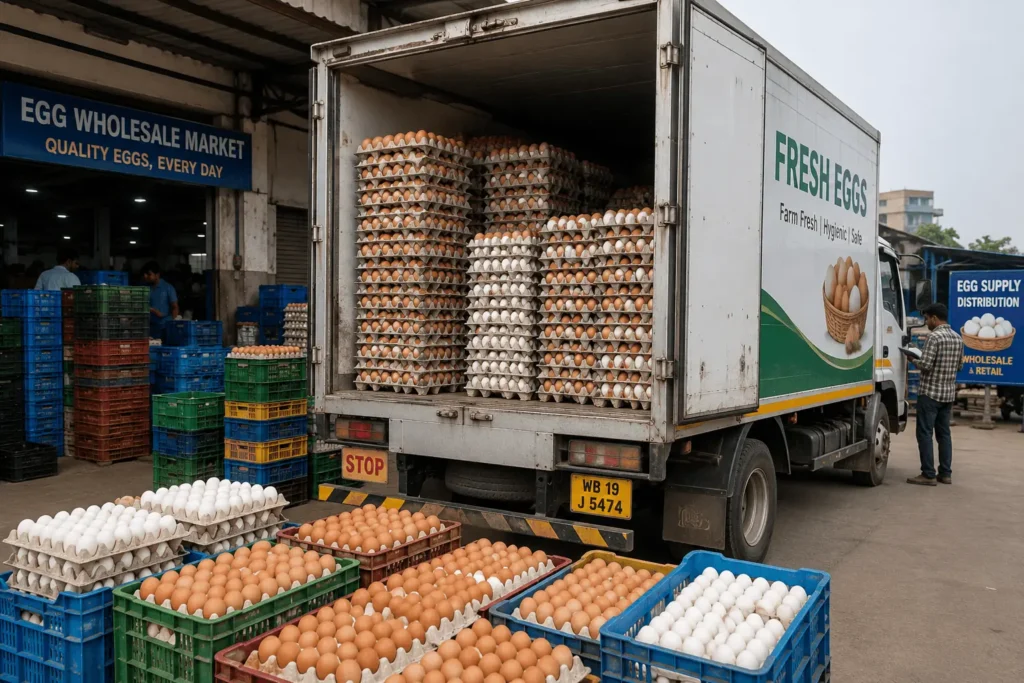
Hyderabad’s distribution network moves fast. Eggs that left a farm in Nalgonda the previous afternoon are typically in a Hyderabad restaurant kitchen by the next morning. Speed and perishability drive the entire logistics chain here.
Price Factors
What Affects Today Egg Rate in Hyderabad?
Three factors consistently move Hyderabad egg rate more than anything else. Understanding them explains why the price you see this morning may differ from what you saw yesterday, or from what Hyderabad’s rate looked like the same week last month.
Demand from Hotels and Food Businesses
Hyderabad has one of the most active commercial food economies in South India. The city is famous for its food culture, and eggs feature heavily across every segment — from the city’s iconic street food to five-star hotel breakfast operations.
Hotels and Large Restaurants
Hyderabad’s hospitality sector spans everything from HITEC City’s business hotels to heritage properties in Banjara Hills and Jubilee Hills. Hotel breakfast operations, restaurant menus, and banquet catering all run on eggs daily. High corporate and tourism occupancy between October and March amplifies this demand significantly.
Bakeries and Irani Cafes
Hyderabad has a uniquely strong cafe and bakery culture rooted in its Irani cafe tradition. Bun maska, egg puff, and Osmania biscuits are Hyderabad staples that require eggs at scale. Established bakeries in areas like Abids, Nampally, and Mehdipatnam are among the city’s most consistent commercial egg buyers.
IT and Corporate Cafeterias
HITEC City, Gachibowli, and Nanakramguda house hundreds of technology companies with large employee cafeterias. These operations buy eggs through contracted distributors and maintain consistent daily volumes regardless of market price fluctuations. Their collective demand is one of the most stable inputs in Hyderabad’s egg market.
Catering Businesses
Hyderabad’s large-scale wedding and event catering industry is one of the most active in India. The city’s culture of large celebrations means catering businesses operate year-round at significant volumes. Biryani catering alone, which often features egg variants, generates consistent egg demand from specialist caterers across the city.
Educational Institutions
Hyderabad has a large concentration of universities, residential colleges, and coaching institutes. Hostel mess facilities and student canteens across Osmania University area, Jubilee Hills, and Kukatpally buy eggs in bulk through regular supply arrangements, adding a steady institutional floor to the city’s daily demand.
Street Food and Tiffin Centres
Hyderabad’s street food scene is dense and busy. Egg bajji stalls, omelette centres, and roadside tiffin sellers are spread across every neighbourhood from Old City to the IT corridors. These small vendors collectively consume a meaningful volume of eggs each day, adding retail-level demand pressure on top of the larger commercial buyers.
On days when all of these demand segments are active simultaneously, supply can struggle to keep pace. That is when today’s egg rate in Hyderabad tends to push above the NECC benchmark rather than trading at or below it.
Poultry Supply from Telangana and Nearby States
Hyderabad’s supply position is stronger than most South Indian cities because Telangana has a well-developed commercial egg production base. The state’s proximity to the city means eggs can reach wholesale markets in Hyderabad the same day they leave a farm, without the overnight-transport cost that cities like Mumbai or Kolkata must absorb.
Primary Supply
Telangana Districts
Ranga Reddy, Nalgonda, and Mahbubnagar are the most important egg-producing districts for Hyderabad’s market. Layer farms here dispatch eggs on short routes that arrive fresh in Hyderabad within hours. When these districts produce well and deliveries are regular, Hyderabad’s wholesale price stays competitive and stable.
Secondary Supply
Andhra Pradesh
Andhra Pradesh is one of India’s largest egg-producing states and a regular supplementary source for Hyderabad. Districts like Chittoor, Krishna, and West Godavari supply eggs to the city when Telangana production alone is not sufficient. The AP supply route is well-established and provides Hyderabad with meaningful supply flexibility that many other cities lack.
Tertiary Supply
Karnataka and Tamil Nadu
Karnataka and Tamil Nadu, particularly farms around Namakkal and Bengaluru’s surrounding districts, supply eggs to Hyderabad during periods of peak demand or when regional supply from Telangana and AP is under pressure. These longer-distance consignments carry higher transport costs, which is directly reflected in the Hyderabad egg rate on days when the market leans on these sources.
Price Impact
How Supply Affects the Rate
The mix of supply sources on any given morning has a direct effect on today’s egg rate in Hyderabad. Heavy arrivals from nearby Telangana farms at low transport cost keep prices steady or push them lower. Dependence on AP or Karnataka supply adds cost. When multiple supply sources are simultaneously disrupted by weather, disease, or logistics failures, prices can spike sharply within 24 hours.
Weather and Transportation
Hyderabad’s climate and geography create specific seasonal price pressures that are distinct from what most other Indian cities experience.
- Summer heat (March to June): Hyderabad’s pre-monsoon season is one of the hottest in India. Temperatures regularly exceed 40°C, which stresses layer flocks and reduces egg-laying rates on farms across Telangana. Supply tightens at the same time that consumer demand softens due to the heat. The net effect on price depends on which factor dominates, but supply disruption from heat stress is a real and recurring annual occurrence in Hyderabad’s market.
- Monsoon season (June to September): Heavy rainfall in Telangana can flood rural roads and delay farm-to-market transport. Hyderabad itself receives significant monsoon rainfall, which can disrupt last-mile distribution within the city. Short-term price spikes on days with severe rainfall are common, even when overall supply levels are normal, simply because eggs cannot move efficiently from farms to wholesale markets.
- Transportation costs and fuel: Diesel prices affect every truck delivering eggs to Hyderabad’s wholesale markets. Telangana farm supply is cost-efficient given the short distances, but supply from AP and further states is more exposed to fuel price movements. When diesel prices rise nationally, Hyderabad’s egg rate tends to edge up within a few days as transport operators pass the cost through the supply chain.
- Road infrastructure and logistics: The highway corridors from Nalgonda, Mahbubnagar, and Ranga Reddy into Hyderabad are generally well-maintained, which keeps regular supply moving efficiently. However, construction disruptions on the Outer Ring Road or highway maintenance on major AP supply routes can create temporary logistical bottlenecks that appear in the market as short-term price pressure.
Hyderabad’s advantage is that most of its primary supply comes from short distances within Telangana. But this also means any weather or logistics problem affecting Telangana specifically hits the Hyderabad market harder than cities with more geographically diversified supply sources.
Annual Price Trends
Hyderabad Egg Rate Trends Throughout the Year
Hyderabad’s egg prices follow a recognisable annual cycle that experienced traders in the city use to plan purchases and manage supply contracts. Prices do not stay constant throughout the year, and knowing which months typically bring higher or lower rates helps buyers make better timing decisions.
Oct to Jan
Peak Season
Hyderabad’s coolest and most festive months. Dussehra, Diwali, Eid, and Christmas all fall in this window. Hotel occupancy peaks with business conferences and domestic tourism. Household consumption rises with cooler temperatures. The egg rate in Hyderabad typically runs at its highest during this period.
Feb to Mar
Transition
Post-festival demand settles. Corporate activity continues at normal levels but hospitality demand eases after the peak season. Prices moderate from their peak but remain above the summer lows. A period of relative market stability before the summer heat begins to affect supply.
Apr to Jun
Summer Softening
Hyderabad’s intense pre-monsoon heat reduces household egg appetite significantly. Layer farm output from Telangana drops due to heat stress. Demand softens but so does supply, which creates a mixed price environment. Prices are generally lower than peak season but can spike briefly if heat stress on farms is severe.
Jul to Sep
Monsoon Volatility
Demand recovers as temperatures drop, but monsoon disruptions to transport create unpredictable short-term price spikes. Some of Hyderabad’s sharpest single-day price movements happen during the monsoon months, when heavy rainfall combines with recovering demand to create sudden supply shortfalls at wholesale markets.
Festival Demand and Its Effect on Hyderabad Egg Prices
Hyderabad’s festival calendar is long and diverse, and it creates a series of demand peaks throughout the year that consistently push the egg rate upward. The city’s mixed cultural and religious character means major events happen across different communities at different times of year, which means there are few extended quiet periods in the egg market.
- Ramadan and Eid: Hyderabad has one of the largest Muslim populations of any Indian city, and Ramadan creates significant demand for egg-based iftar dishes and Eid celebration cooking. Egg prices in the city regularly rise in the weeks leading up to and during Ramadan, as both household and catering demand increases together.
- Dussehra and Diwali: These back-to-back festivals in October and November create some of the sharpest demand peaks of the year. Hotels fill with domestic travellers, caterers handle large event bookings, and household buying surges simultaneously. The compounding effect on demand during a three to four week window makes this the most consistently expensive period for egg buyers in Hyderabad.
- Bonalu and Bathukamma: These Telangana-specific festivals generate significant local cooking and celebration-related demand. Their timing in mid-year provides a demand uptick during what would otherwise be a quieter market period, distinguishing Hyderabad’s price pattern from cities that do not observe these regional festivals.
Buyers who plan large purchases around Hyderabad’s festival calendar consistently get better results than those who buy at spot prices during peak demand periods. The egg rate today in Hyderabad during Ramadan or Diwali week is almost always higher than it was two weeks before those events began.
Hyderabad egg rates are shaped by a wider range of festivals and cultural events than most comparable Indian cities. Planning purchases around the city’s festival calendar is one of the most practical ways for commercial buyers to manage their monthly egg costs effectively.
Browse Egg Rates by City
Browse the cities below to check today’s live egg rates, monthly price trends, and historical market data.
QUESTIONS