
Barwala Egg Rate Today
Updated 30th August 2026 · Source: NECC Barwala
Today’s Rate
₹5.61 /piece
Tray Price
₹168.30 (30 Eggs)
Retail Price
₹6.28
Supermarket Rate
₹6.17
As of 30th August 2026: Today’s Barwala egg rate is ₹5.61 per egg. A tray of 30 eggs costs ₹168.30, while 100 eggs are priced at ₹561.00 and 1 peti costs ₹1,178.10. The current retail and supermarket rates are ₹6.28 and ₹6.17. Check the updated last month complete rates and summary below in the table and charts.
PRICE TREND
Barwala Egg Rate Summary & Trend
Track recent movements in Barwala egg prices with a quick monthly summary and interactive price trend chart. See the highest, lowest, and average rates to understand how the local market has changed over recent days.
Highest
₹5.61 on 30 Aug
Lowest
₹4.88 on 1 Aug
Average
₹5.14 So far this month
FULL BREAKDOWN
Barwala Egg Rates (Last 30 Days)
Browse Barwala egg prices from the last 30 days, including rates per egg, tray, 100 eggs, and peti. Compare daily price changes and review recent market activity in one place.
| Date | Piece (₹) | Tray/30 (₹) | 100 Pcs (₹) | Peti/210 (₹) |
|---|---|---|---|---|
| 30 Aug 2026 | ₹5.61 | ₹168.30 | ₹561.00 | ₹1,178.10 |
| 29 Aug 2026 | ₹5.61 | ₹168.30 | ₹561.00 | ₹1,178.10 |
| 28 Aug 2026 | ₹5.46 | ₹163.80 | ₹546.00 | ₹1,146.60 |
| 27 Aug 2026 | ₹5.33 | ₹159.90 | ₹533.00 | ₹1,119.30 |
| 26 Aug 2026 | ₹5.30 | ₹159.00 | ₹530.00 | ₹1,113.00 |
| 25 Aug 2026 | ₹5.30 | ₹159.00 | ₹530.00 | ₹1,113.00 |
| 24 Aug 2026 | ₹5.12 | ₹153.60 | ₹512.00 | ₹1,075.20 |
| 23 Aug 2026 | ₹5.04 | ₹151.20 | ₹504.00 | ₹1,058.40 |
| 22 Aug 2026 | ₹5.00 | ₹150.00 | ₹500.00 | ₹1,050.00 |
| 21 Aug 2026 | ₹5.00 | ₹150.00 | ₹500.00 | ₹1,050.00 |
| 20 Aug 2026 | ₹5.11 | ₹153.30 | ₹511.00 | ₹1,073.10 |
| 19 Aug 2026 | ₹5.11 | ₹153.30 | ₹511.00 | ₹1,073.10 |
| 18 Aug 2026 | ₹5.11 | ₹153.30 | ₹511.00 | ₹1,073.10 |
| 17 Aug 2026 | ₹5.11 | ₹153.30 | ₹511.00 | ₹1,073.10 |
| 16 Aug 2026 | ₹5.11 | ₹153.30 | ₹511.00 | ₹1,073.10 |
| 15 Aug 2026 | ₹5.11 | ₹153.30 | ₹511.00 | ₹1,073.10 |
| 14 Aug 2026 | ₹5.11 | ₹153.30 | ₹511.00 | ₹1,073.10 |
| 13 Aug 2026 | ₹5.11 | ₹153.30 | ₹511.00 | ₹1,073.10 |
| 12 Aug 2026 | ₹5.11 | ₹153.30 | ₹511.00 | ₹1,073.10 |
| 11 Aug 2026 | ₹5.11 | ₹153.30 | ₹511.00 | ₹1,073.10 |
| 10 Aug 2026 | ₹5.11 | ₹153.30 | ₹511.00 | ₹1,073.10 |
| 09 Aug 2026 | ₹5.11 | ₹153.30 | ₹511.00 | ₹1,073.10 |
| 08 Aug 2026 | ₹5.11 | ₹153.30 | ₹511.00 | ₹1,073.10 |
| 07 Aug 2026 | ₹5.11 | ₹153.30 | ₹511.00 | ₹1,073.10 |
| 06 Aug 2026 | ₹5.08 | ₹152.40 | ₹508.00 | ₹1,066.80 |
| 05 Aug 2026 | ₹5.03 | ₹150.90 | ₹503.00 | ₹1,056.30 |
| 04 Aug 2026 | ₹5.00 | ₹150.00 | ₹500.00 | ₹1,050.00 |
| 03 Aug 2026 | ₹5.00 | ₹150.00 | ₹500.00 | ₹1,050.00 |
| 02 Aug 2026 | ₹4.95 | ₹148.50 | ₹495.00 | ₹1,039.50 |
| 01 Aug 2026 | ₹4.88 | ₹146.40 | ₹488.00 | ₹1,024.80 |
About Barwala Egg Market
Barwala is a town in Hisar district, Haryana, and one of India’s most important commercial egg production centers. The Barwala egg rate today is one of the most searched egg price references in North India, and for good reason.
The area around Barwala is home to a large cluster of commercial layer farms. These farms run cage-based operations with hundreds of thousands of birds producing eggs continuously. The scale of production in and around Barwala is comparable to other major hubs like Namakkal in Tamil Nadu or Pune in Maharashtra, but Barwala serves a completely different geography.
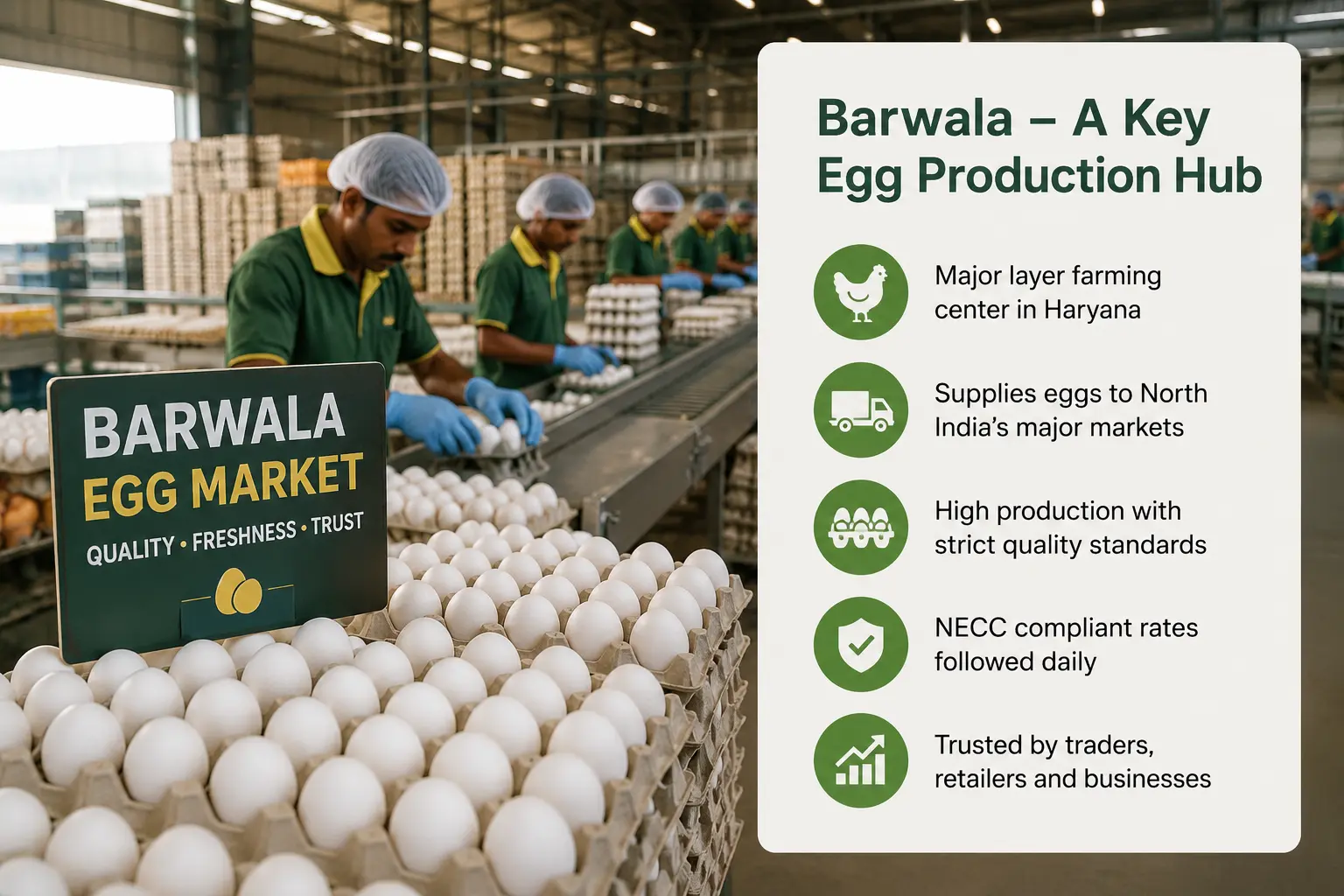
Unlike southern production centers that supply mainly to peninsular India, Barwala feeds the northern corridor. Delhi, Punjab, Himachal Pradesh, Chandigarh, Rajasthan, Jammu and Kashmir, and parts of Uttar Pradesh all draw on Barwala’s output. This makes Barwala the most strategically placed egg production market for North India.
Barwala is not just one farm or one mandi. It refers to a concentrated belt of poultry operations in the Hisar region that collectively produce enough volume to influence prices across six to seven states in one direction or another.
Why Barwala Egg Rates Matter Across India?
Most egg production in India is concentrated in the south and west. Andhra Pradesh, Telangana, and Tamil Nadu together dominate national output. But those production centers are far from North India. Barwala fills that gap, making it the primary production benchmark for the entire northern market.
When Barwala’s production is strong, North India’s egg supply is steady and prices remain in check. When Barwala production drops even slightly, markets from Delhi to Jammu feel it within a day or two.
Which markets follow Barwala rates?
Why do traders monitor the Barwala egg rate daily? Because even a ₹0.10 to ₹0.20 change per egg in Barwala’s wholesale rate multiplies significantly when you are buying 10,000 to 50,000 eggs at a time. A large Delhi distributor can see cost changes of ₹5,000 to ₹10,000 on a single day’s purchase based on the Barwala rate movement.
In practical terms, the Barwala mandi rate functions as the North India equivalent of what Namakkal is to the south. Commission agents, wholesale buyers, and transport operators all price their day around what Barwala posts each morning.
Barwala is listed as an official NECC production center. This means its daily rate is published alongside other major hubs on the NECC rate sheet, giving it formal recognition as a national pricing benchmark.
How Are Barwala Egg Prices Determined?
The daily egg rate for Barwala does not come from a single person or organization making a unilateral decision. It is the result of a coordinated process that happens every morning before trading begins.
- 1Farm-Level Production AssessmentLocal poultry farmers and layer farm operators report the day’s expected production volumes. If flock sizes are strong and laying rates are normal, supply is plentiful and prices tend to stay flat or ease.
- 2Demand Signals from BuyersCommission agents and wholesale buyers from Delhi, Punjab, and other states communicate what volumes they expect to lift that day. High demand against available supply pushes the rate up.
- 3NECC Reference RateNECC publishes a national suggested rate each morning. Barwala’s local market rate is typically set in relation to the NECC published figure, adjusted for local supply and transport conditions.
- 4Mandi Opening RateThe local trader association or mandi at Barwala declares the opening rate for the day. This is the rate most commission agents and buyers use as the starting point for the day’s transactions.
- 5Transport Cost AdjustmentFor buyers in distant markets like Shimla or Jammu, transport costs are added on top of the Barwala mandi rate. The farther the destination, the larger this addition.
The published Barwala egg rate you see each morning is essentially the mandi rate at the point of dispatch. By the time eggs reach a retail shop in Delhi or a hotel kitchen in Chandigarh, the price has already moved higher to account for transport, handling, and margin.
Factors Affecting Barwala Egg Prices
Several things push Barwala egg prices up or down on any given day. Some are seasonal and predictable. Others are sudden and harder to plan for. Here is a breakdown of each factor.
A practical example: during Ramadan, egg demand from Muslim-majority markets in Uttar Pradesh and Jammu increases. That extra pull on Barwala’s supply often pushes the local rate up by ₹0.20 to ₹0.40 per egg.
But when maize prices rise nationally or soybean meal becomes expensive due to import costs, Barwala farmers also feel the pressure and adjust their selling prices accordingly.
• Summer (May to June): Heat stress reduces laying rates in poorly ventilated sheds. Production dips while demand from Delhi remains steady, pushing prices up.
• Winter cold snaps: Harsh cold can cause bird mortality in open-sided farm structures, temporarily reducing supply exactly when winter demand is at its peak.
• Oct to Feb: Peak season. Prices generally highest.
• Mar to May: Demand softens. Prices ease.
• June to Sep: Monsoon season. Transport disruptions add cost even if demand is moderate.
Buyers planning large purchases use this cycle to time orders and manage inventory costs.
During monsoon season, NH routes toward the hills get affected. This raises the landed cost of Barwala eggs in those markets even if the Barwala mandi rate itself has not moved. Diesel price increases also flow directly into egg distribution costs across all destinations.
Because Barwala is the dominant northern production hub, even a 10 to 15% production drop here has a measurable effect on prices in Delhi within 48 hours.
Who Uses Daily Barwala Egg Rates?
The Barwala egg price is not just useful for people inside Barwala. Anyone involved in the egg supply chain across North India tracks this number because it determines their buying cost, selling margin, or daily budget. Here is who checks it every morning and why.
Why Check Barwala Egg Rates Daily?
The Barwala egg rate can change every single day. Sometimes it moves by ₹0.10. Other times it shifts by ₹0.50 or more within 24 hours. For anyone buying or selling eggs in North India, a one-day gap in price information can mean a real financial difference.
Here is why checking the rate daily is practical, not just habit:
- Better buying decisions. When the rate drops, it is a good time to buy in volume. When it is rising, experienced buyers often hold smaller inventory to avoid overstocking at peak prices.
- Accurate retail pricing. Retailers who do not track the wholesale rate daily often either undercharge and lose margin or overcharge and lose customers. The daily rate keeps pricing decisions grounded in actual market conditions.
- Spot price trends early. Three or four consecutive days of rising Barwala egg rates usually signal a supply issue or a demand surge building in the market. Tracking daily lets you act before the full impact hits.
- Plan seasonal purchases. If you know Barwala prices rise every October, you can time bulk purchases for September to lock in lower costs before the seasonal price increase arrives.
- Compare with other markets. Checking the Barwala rate alongside rates from Delhi, Namakkal, or other nearby cities gives you a clearer picture of where North India’s supply chain stands on any given day.
This page updates the Barwala egg rate every morning before 7 AM IST. The rate shown reflects the NECC published rate for Barwala, alongside tray and peti prices calculated for your reference. For nearby city rates, you can check Delhi, Punjab, and other North India markets from the city pages on this site.
Explore Egg Rates by City
Explore egg rates from other major markets across India. Select a city below to view today’s egg prices, recent market trends, and historical rate information.
QUESTIONS